 WhatsApp Us
Silane Modified Polymers in Waterproof Coatings
Most waterproof coatings fail not because they lack water resistance — but because they can’t hold their bond when the substrate moves, expands, or weathers. That’s the actual problem. And it’s precisely where silane-modified polymer chemistry earns its place.
What the Chemistry Actually Does
An SMP — silane-modified polymer, also called silane-terminated polyether (STPE) — is a polymer chain with alkoxysilane groups capped at its ends. When exposed to atmospheric moisture, those terminal groups hydrolyze into silanol intermediates. The silanols then condense to form –Si–O–Si– siloxane bonds, creating a three-dimensional crosslinked network.
This two-stage mechanism — hydrolysis, then condensation — is not incidental. It’s the source of every meaningful performance difference between SMP-based coatings and conventional alternatives.
The siloxane bond (Si–O) requires significantly more energy to break than the urethane bonds (–NH–CO–O–) in polyurethane. That’s why SMP coatings don’t yellow under sustained UV exposure the way PU does — the backbone simply doesn’t degrade through the same photoxidative pathway.
Adhesion: The Mechanism, Not the Claim
The adhesion performance of SMP coatings comes from a specific molecular interaction. On inorganic substrates — concrete, glass, metal — the silanol groups formed during curing react directly with surface hydroxyl groups (Si–OH on glass, M–OH on metal oxides). This creates a covalent bond at the interface, not just mechanical interlocking.
This is why Manta MS330A and Manta MS330C both demonstrate primerless adhesion across porous and non-porous substrates. In a standard 1K formulation using 30–40 parts MS330A, tensile strength reaches 0.77 MPa with elongation at break of 109% — the coating stretches with the substrate rather than tearing away from it.
That said, this mechanism has a limit. On substrates with high free calcium (e.g., freshly cast concrete at pH > 12–13), the silane condensation competes with calcium ion interference. In those conditions, surface pre-treatment or an amino-silane adhesion promoter is necessary before applying an SMP-based waterproof coating.
Flexibility Under Real Conditions
A rooftop membrane in a temperate climate undergoes thermal cycling of roughly ±40°C seasonally. At that range, concrete moves. An inelastic coating cracks — it’s not a question of if, but when.
SMPs address this structurally. The polyoxypropylene (PPO) backbone has a very low glass transition temperature (Tg), well below 0°C in most grades. The crosslinked network remains rubbery and flexible at winter temperatures when brittle failure is most likely. Manta MS330B (viscosity 60,000–70,000 mPa·s, Shore A hardness ~34) is specifically suited for high-movement roofing applications where the coating must accommodate both substrate movement and foot traffic.
For coatings formulated for below-grade or basement applications — where substrate movement is lower but hydrostatic pressure is higher — a medium-to-high modulus grade like Manta MS312 (Shore A ~40, elongation 60%) provides better resistance to pressure-driven water ingress without the compliance overhead.
Why SMP Outperforms PU and Silicone in Waterproofing
This comparison is worth being precise about:
| Property | SMP | Standard PU | Silicone |
| Isocyanate content | None | Present (health risk) | None |
| UV / yellowing resistance | High (Si–O backbone) | Low (urethane bonds degrade) | Very high |
| Adhesion to mineral substrates | Covalent bond (primerless) | Mechanical (primer often needed) | Poor without primer |
| Elongation at break | 100–300%+ | 300–800% | 100–600% |
| Overpaintability | Yes | Grade-dependent | Generally poor |
| VOC / odor during cure | None | CO₂ / solvent odor | Low |
Silicone has better elongation and broader temperature range, but its adhesion to concrete and metal without primer is poor — a real limitation in field-applied waterproofing. Polyurethane delivers higher elongation but degrades under UV and carries isocyanate handling risk during production. SMP lands in the practical middle for most construction waterproofing use cases.
Where SMP-Based Coatings Are Used — and Where They Aren’t
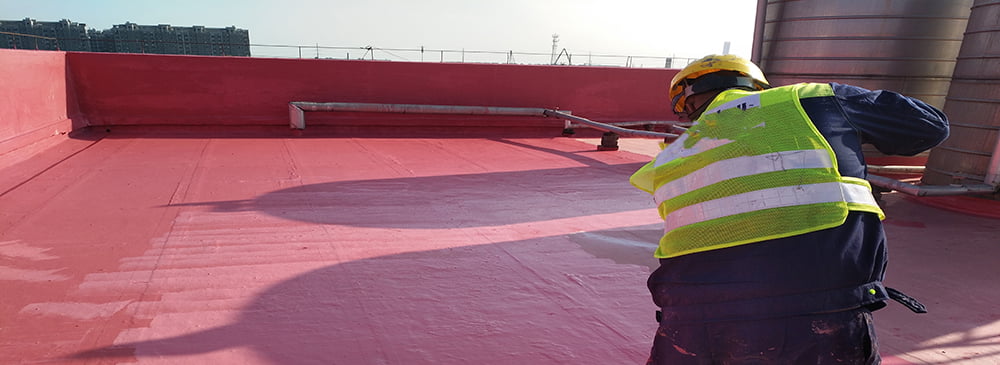
Roofing and exposed decks: Manta MS330B and MS330A are appropriate here. The high UV resistance and flexible crosslinked network handle thermal cycling and sustained weather exposure.
Tunnels, basements, and below-grade structures: Manta MS312 or MS305D (Shore A 70, high modulus) handle the higher mechanical demands of substrate pressure and ground movement.
Bridge decks and infrastructure exposed to de-icing salts: SMP coatings provide both physical water exclusion and chemical resistance to chloride-bearing solutions — a combination that conventional acrylic waterproofing does not offer.
Expansion joints: Manta MS27 (low modulus, high elasticity) or MS7500 is more appropriate than high-modulus grades. Joint movement requires accommodation, not resistance.
One application where SMP does not perform well: surfaces continuously submerged in standing water. Full immersion over extended periods can compromise the siloxane network’s hydrolytic stability depending on formulation — especially in low-modulus grades with high plasticizer content. For water tanks and immersion-grade applications, an epoxy or specifically engineered SPUR system is a better fit.
Formulating SMP Waterproof Coatings: Key Considerations
A functional 1K SMP waterproof coating typically consists of:
- Base polymer:30–40 parts (e.g., Manta MS330C or MS330A depending on modulus requirement)
- Plasticizer:10–20 parts (PPG or DOTP preferred for low-temperature flexibility)
- Water scavenger:1–2 parts vinyl trimethoxysilane (VTMO) — mandatory for shelf life
- Thixotropic agent:2–5 parts fumed silica (controls sag on vertical surfaces)
- Fillers:40–50 parts GCC or TiO₂
- Adhesion promoter:1–2 parts amino-silane (AMEO or AMMO)
- UV / thermal stabilizers:1–2 parts HALS + hindered phenol antioxidant
- Catalyst:3–0.6 parts — organotin (DBTDL) or tin-free alternatives depending on regulatory requirements
The water scavenger step is non-negotiable. Residual moisture in fillers will trigger premature crosslinking before the coating is applied, collapsing shelf life from 12 months to weeks. VTMO reacts preferentially with free water, protecting the terminal alkoxysilane groups until the coating is applied and intentionally exposed to ambient humidity.
The specific polymer grade you choose determines modulus, cure speed, and movement accommodation — and those three variables drive whether a coating survives two winters or twenty. If you’re specifying an SMP-based waterproof system and need to match grade to substrate conditions, contact Manta’s technical team for formulation support.